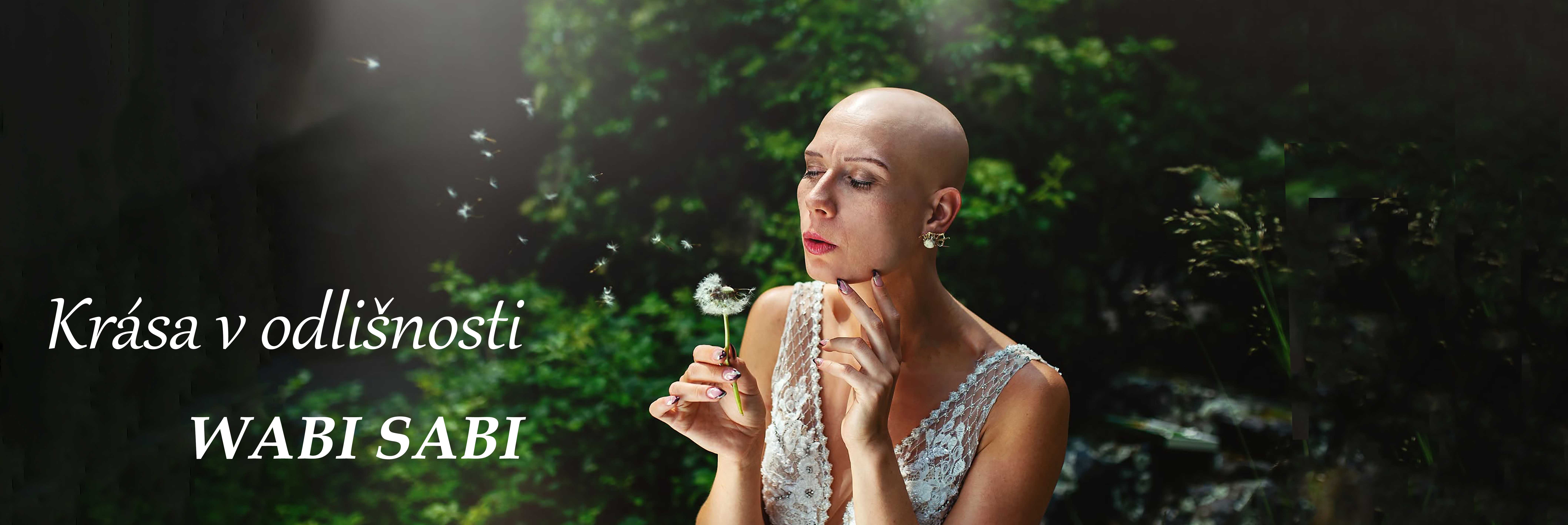
The Wabi Sabi project is an artistic jewelry and innovative project inspired by the Japanese philosophy "Wabi Sabi" (beauty that is born from imperfection, transience and authenticity) and in collaboration with the organization Rovnost tváří (https://www.rovnosttvari.cz/ ).
We live in an era that emphasizes perfection, performance, and conformity. The boundaries of acceptance are becoming narrower, and many who step outside of artificially created categories face intolerance or misunderstanding. Wabi Sabi challenges this reality – showing that what is perceived as a “defect” can be an “effect” and what gives things meaning, depth, and beauty.
The project combines:
– expression through jewelry of the author's personal opinion on this issue,
– education about the differences in appearance and the natural diversity of the world.
– expression through jewelry of the author's personal opinion on this issue,
– education about the differences in appearance and the natural diversity of the world.
Each piece of jewelry from the Wabi Sabi collection is inspired by one specific type of difference – vitiligo, albinism, alopecia, burns and others.
Its basis is nature, which bears the imprint of life – bumps, insect bites, irregular shape, unusual coloration.
These signs are immortalized in metal using a new method and resonate with the given human difference – just like it, they are not a mistake, but a natural part of uniqueness.
Its basis is nature, which bears the imprint of life – bumps, insect bites, irregular shape, unusual coloration.
These signs are immortalized in metal using a new method and resonate with the given human difference – just like it, they are not a mistake, but a natural part of uniqueness.
Each piece of jewelry from the “Wabi Sabi” collection is a visual poetry and a symbol of acceptance. Each photograph is an intimate portrait of human courage.
The entire project is a challenge to change perspective – from judgment to understanding.
Appearance difference does not change the essence – a bitten leaf is still a leaf, silver remains silver – in any artistic form, and a person, no matter what they look like, is always a personality worthy of acceptance and realization.
It’s just a different kind of beauty.
And a different kind of jewelry that we occasionally boldly present.
This collection is not yet on the website and will be presented for the first time at a personal exhibition.
The entire project is a challenge to change perspective – from judgment to understanding.
Appearance difference does not change the essence – a bitten leaf is still a leaf, silver remains silver – in any artistic form, and a person, no matter what they look like, is always a personality worthy of acceptance and realization.
It’s just a different kind of beauty.
And a different kind of jewelry that we occasionally boldly present.
This collection is not yet on the website and will be presented for the first time at a personal exhibition.
Visualization of the planned exhibition
We plan to create a forest installation in the gallery space – a poetic still life of moss, branches, leaves and light as a reference to the fact that everything on display is “normal” for nature and is a part of it. The exhibition will have three symbolic layers – levels:
the upper one – made up of large-format photographs of people with different looks,
the middle one – the jewelry itself, hung or arranged in the space,
the lower one – the “invisible” layers of the creative process: test samples, failures, tools, notes.
An imaginary path – a line of development of the author and her work will lead through the entire space: from the first experiments with electroplating to the current collection “Wabi Sabi”. This path will be represented by objects that will be placed on its sides and symbolically divided into three levels of visibility.
At the beginning of the journey, the bottom layer will dominate: piles of test failures, experimental leaves, broken twigs and fragments that show the path of learning – trials, errors, discovering the physical and poetic properties of natural products and metal. These “waste” artifacts symbolize the courage to make mistakes and learn from them.
In the middle part of the installation, the path will be lined with perfectly executed jewelry – like botanical exhibits – in frames, on glass, under a magnifying glass. Next to them will be other evidence of the professional journey: teaching materials, photos from courses, a professional publication, a book.
On the upper level, a photograph of the author in her working environment is created, tired but with creative fervor in her eyes as a revelation of her true face.
But even here – in the “successful” phase – the bottom layer will remind us that every success has its dark side: exhaustion, burnout, doubts, internal and external criticism. These elements will be depicted visually inconspicuously – as shadows or faded objects in the undergrowth.
The highlight and conclusion of the exhibition is the Wabi Sabi collection itself: jewelry made from natural materials that bear traces of “imperfections” – bites, stains, irregularities, deformations. They are hung or placed so that the light touches them in the same way as the leaves of a tree – with respect.
This part symbolizes acceptance. Freedom from standards and ideals. Maturation. Understanding that imperfection is not weakness, but a different kind of beauty.
The exhibition grows in this way – from a modest beginning to a blooming, layered outcome. It is not only a story of creation, but also stories of people who had the courage to go against expectations – while remaining true to their inner nature.
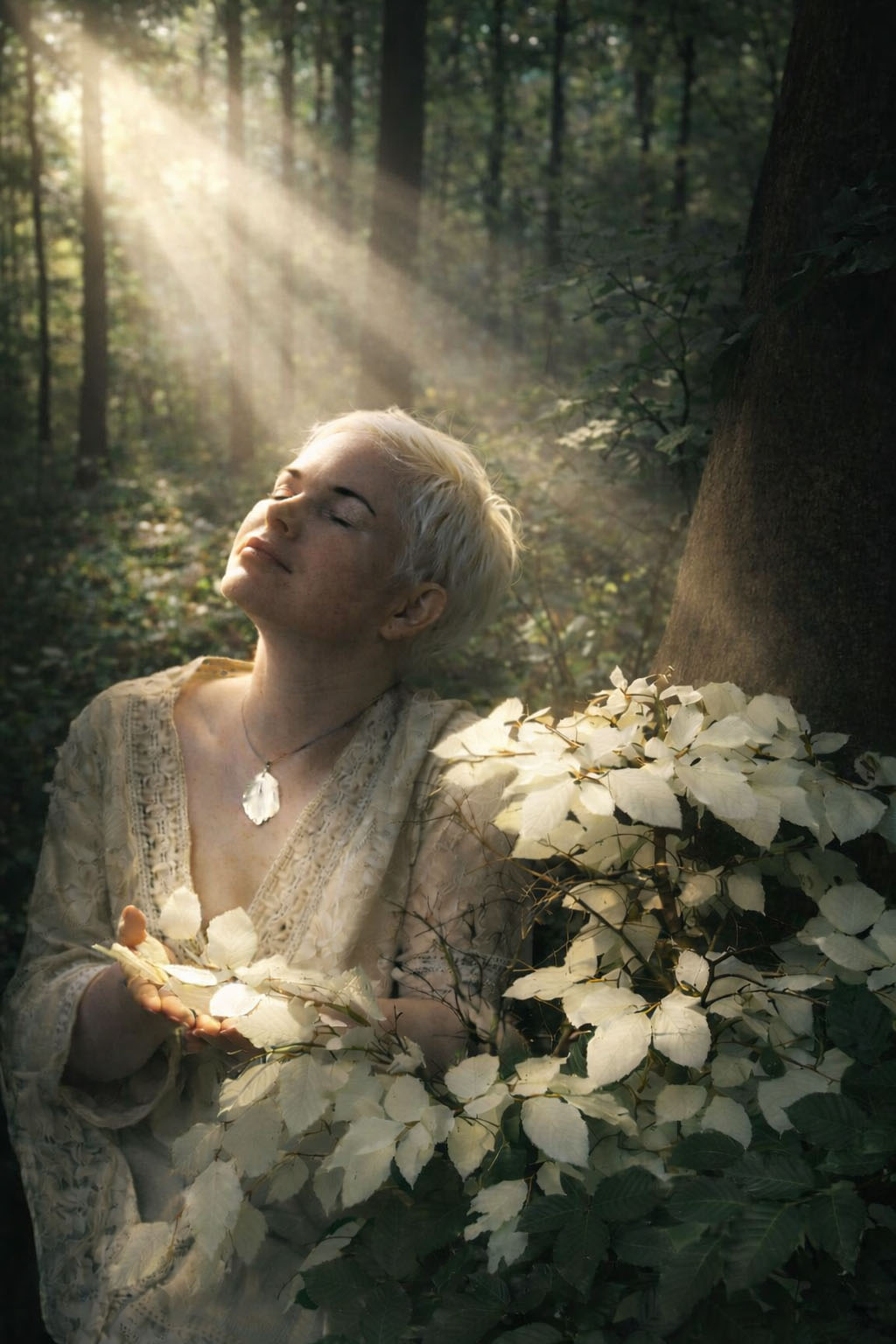
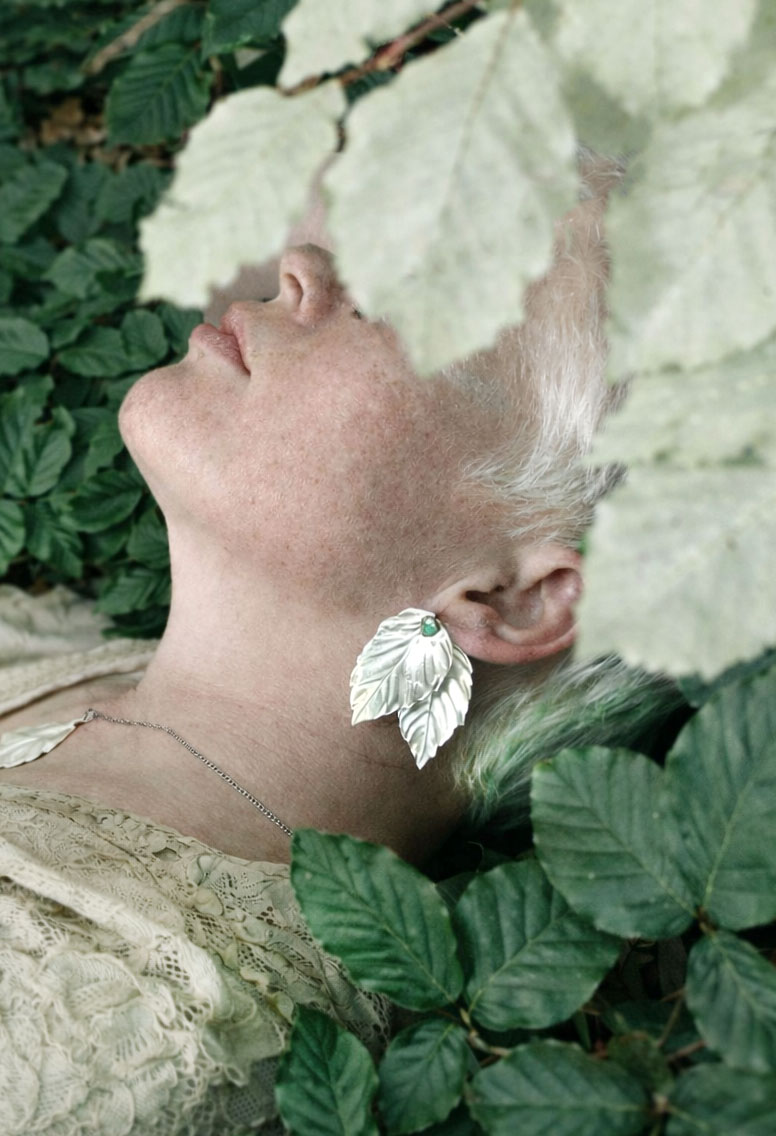
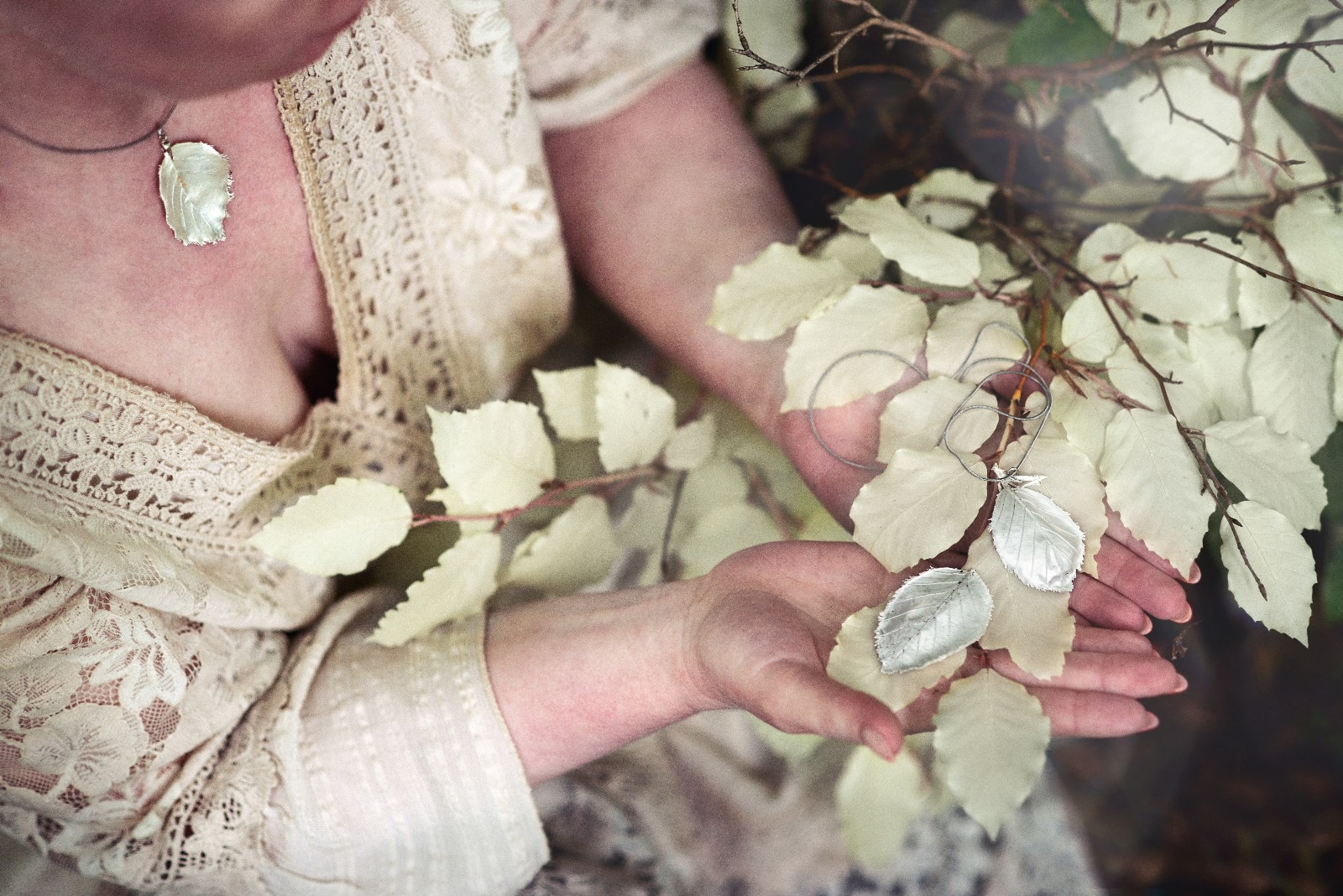
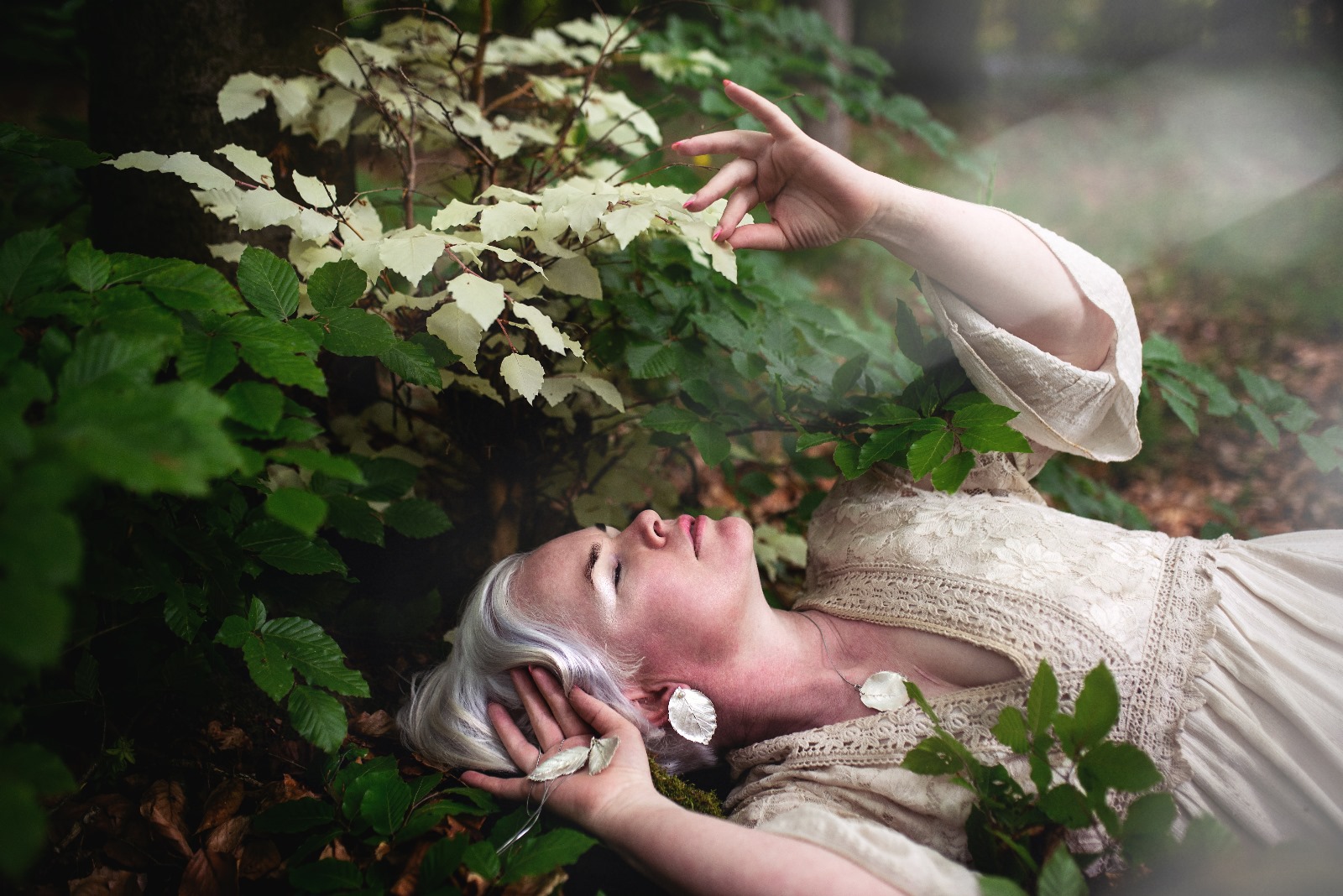
An example of the connection between natural differences and jewelry: Albinism
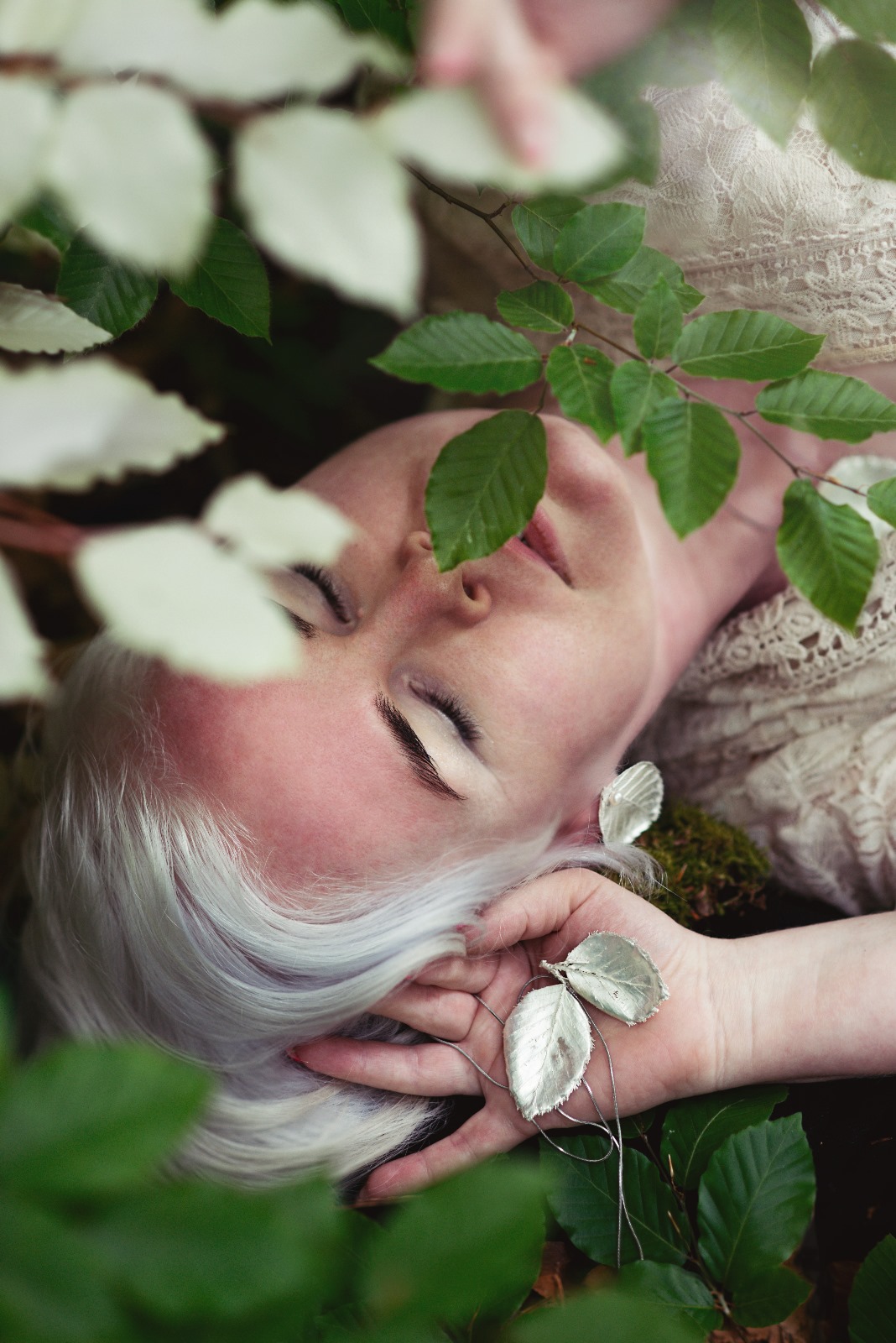
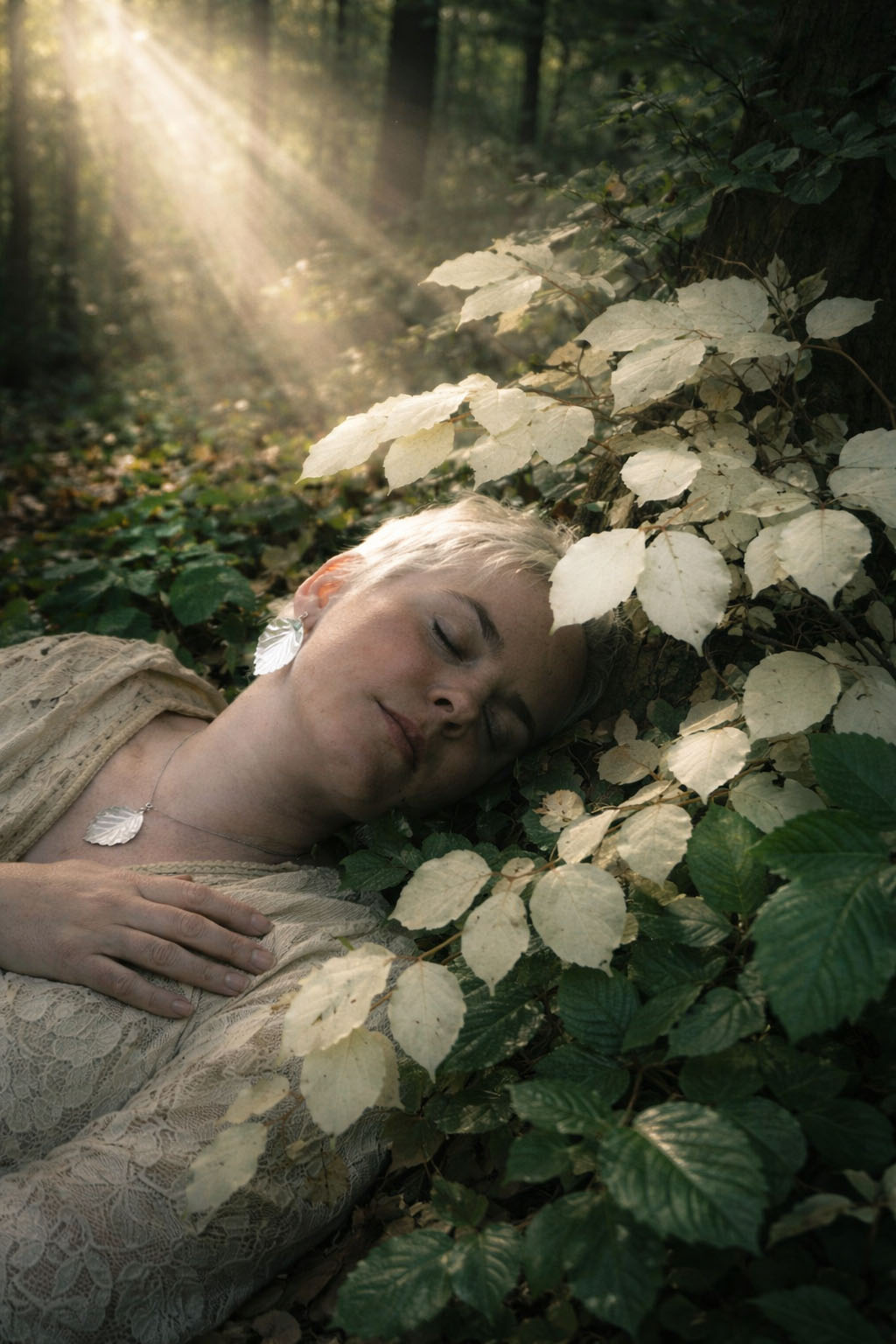
This photograph captures a rare moment – a woman and a tree, connected by a rare phenomenon: albinism.
The model is Tereza Jurná, a woman with a congenital difference in the form of albinism, which manifests itself in light hair, sensitive skin and visual difficulties – but above all, an unmistakable appearance and delicate beauty.
Nearby, an albino beech grows, the only known specimen in the Czech Republic, located in the Moravian Karst. As in humans, in the plant kingdom, albinism means the absence of pigment – a fragile peculiarity, which, however, hides the power of survival and authenticity.
The jewelry that Tereza is wearing was created from real beech leaves, plated with pure silver using the innovative technique of electroplating without a base layer. The leaves bear real traces of life – softness, structure and fragility – just like human skin. This composition is a celebration of difference. It shows that beauty does not arise in perfection, but in the courageous acceptance of oneself as part of nature.
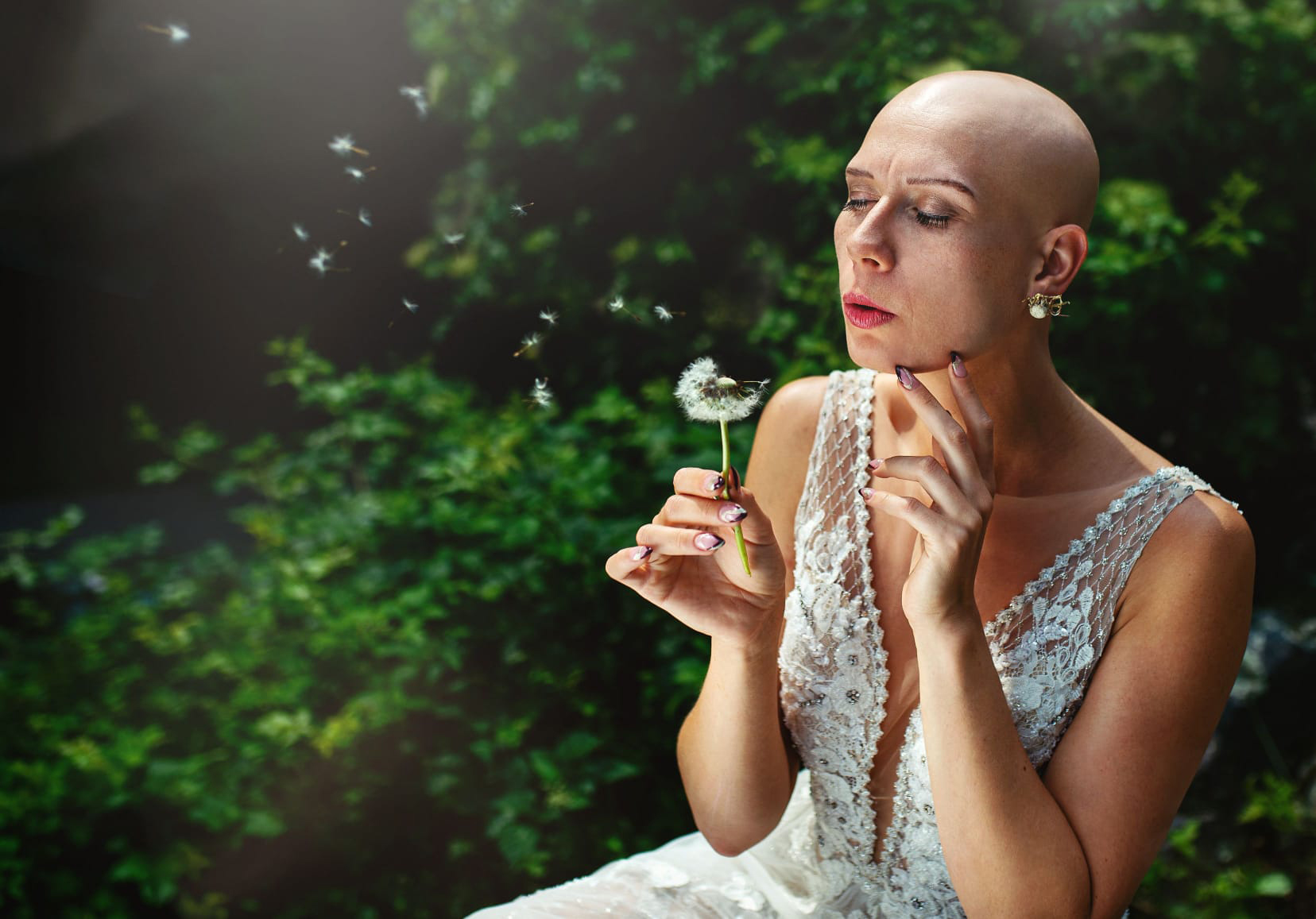
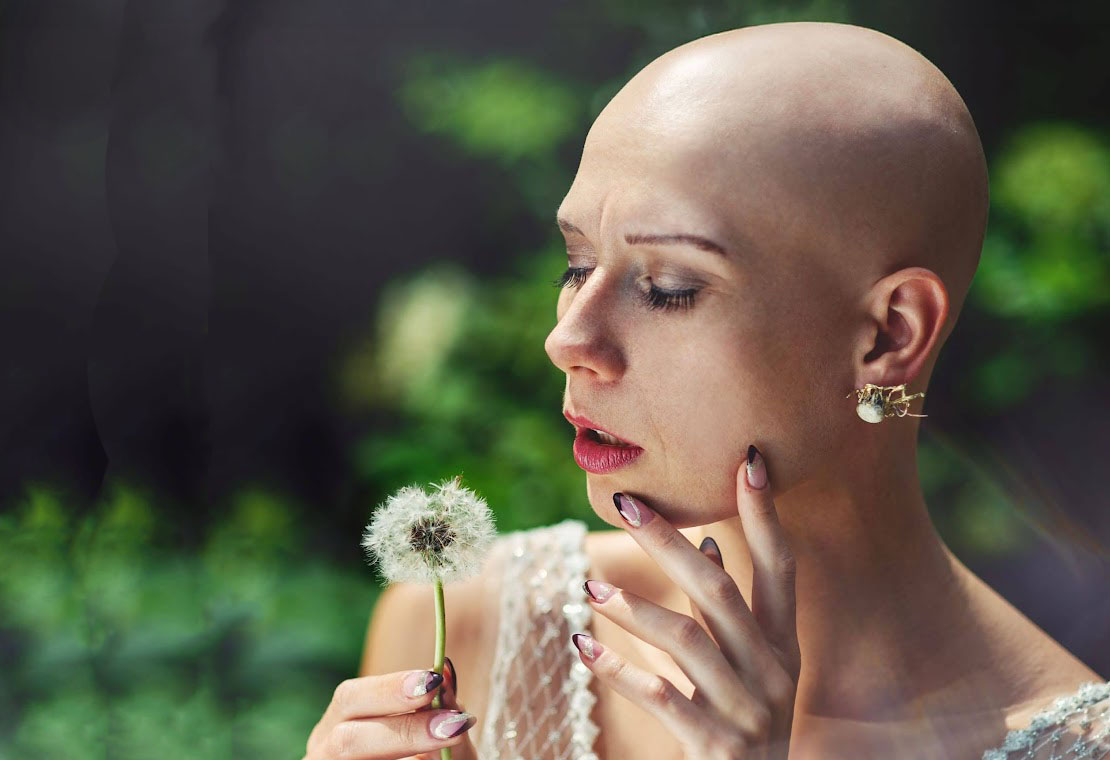
Alopecia (Kateřina Šebek) with a dandelion with fluff flying off it... and the jewelry is also a dandelion!
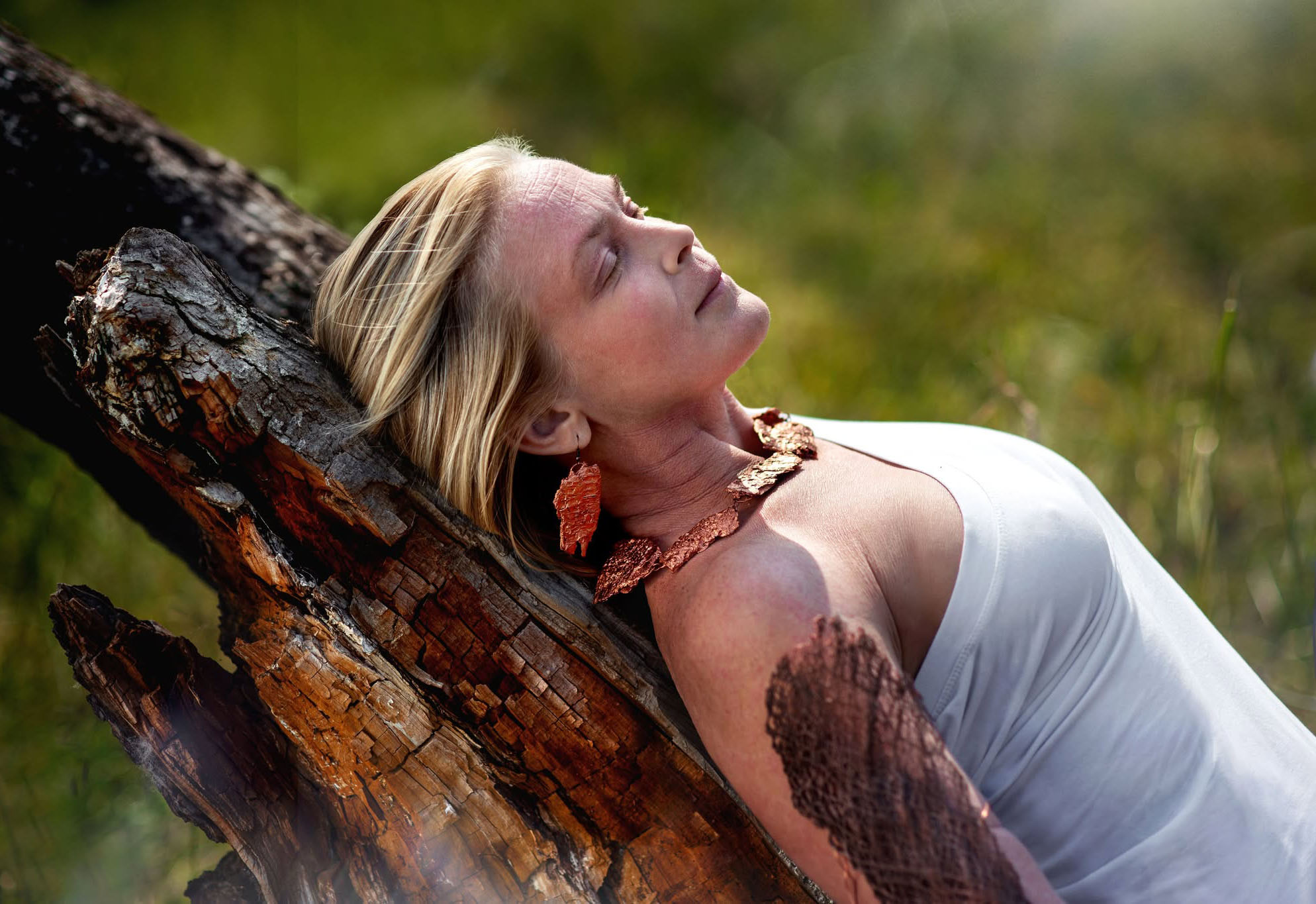
Atopic eczema (Jana Darivčáková) by a tree without bark, with a necklace made of oak bark in metal. 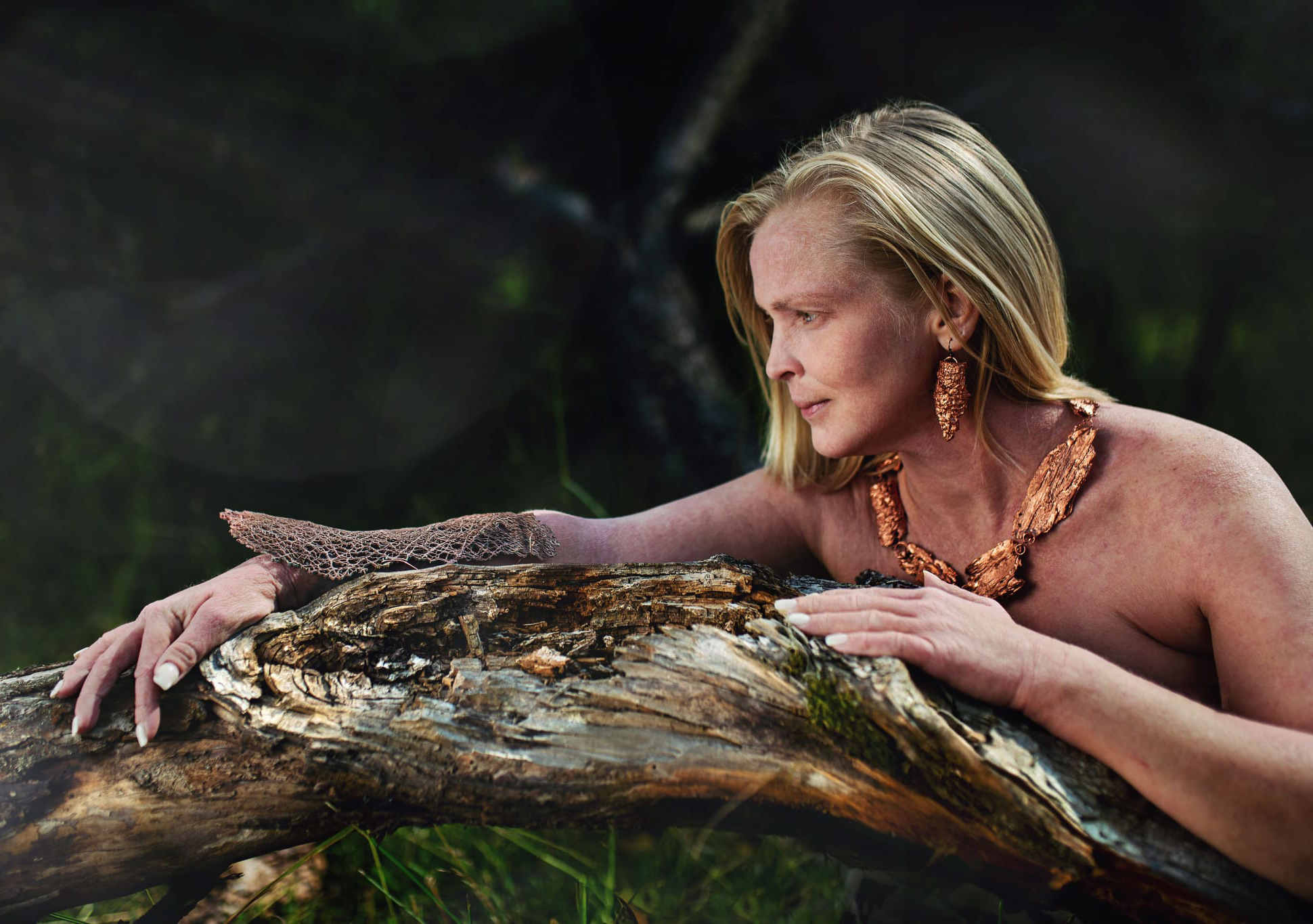
Vitiligo manifestation (Monika Kopčilová) with a jewel-leaf, bitten by an insect
TCS manifestation (Eva Dojčarová) in a clover field with a four-leaf clover in gold (the four-leaf clover is also a genetic mutation of the three-leaf clover)
Ichthyosis and burn manifestations have not yet been photographed, but will be presented in the exhibition.
The original photos are or will be taken in collaboration with photographer Michaela Linhartová, who has experience photographing women suffering from atopic eczema (https://pozitivni-zpravy.cz/boj-s-ekzemem-muze-lidi-spojovat/).
The photos are published with the consent of the models and photographer Michaela Linhartová.